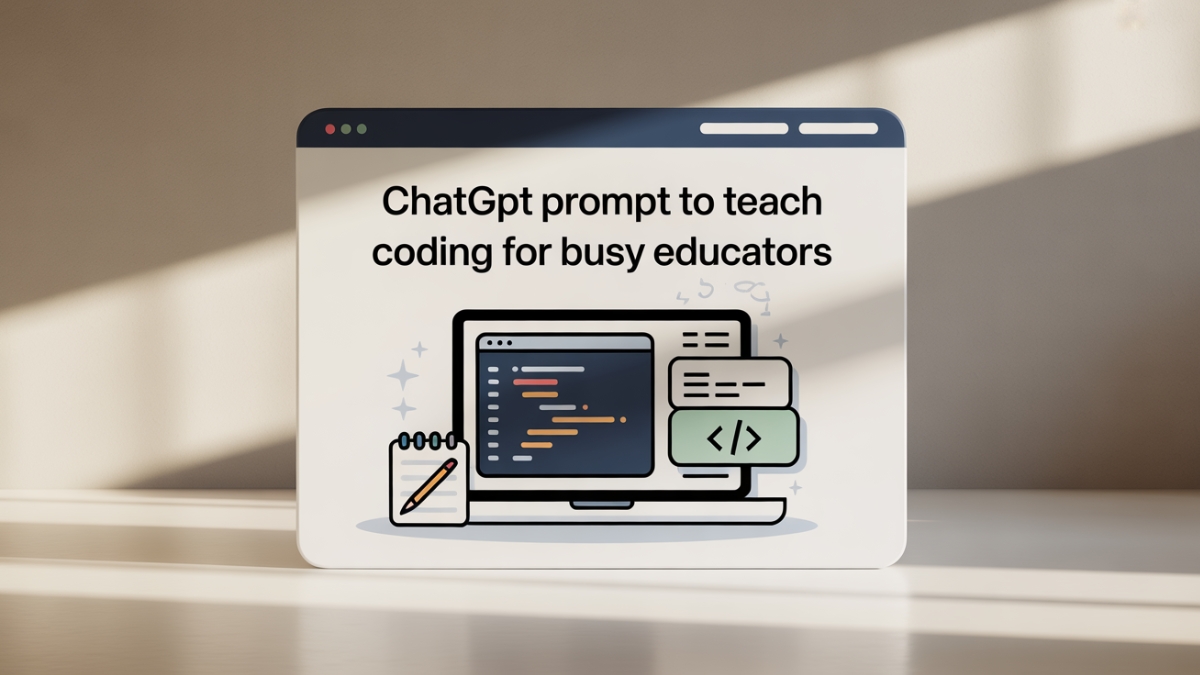
Introduction: Revolutionizing Coding Instruction with ChatGPT
The modern classroom, particularly in the realm of programming education, demands flexibility, efficiency, and engagement. For busy educators, finding the time to prepare effective coding lessons that resonate with diverse learners is a persistent challenge. This is where the chatgpt prompt to teach coding steps in as a revolutionary tool. By leveraging advanced AI-driven language models like ChatGPT, instructors can reduce the tedious hours of lesson preparation, while delivering high-quality, interactive content tailored to their students’ needs.
ChatGPT offers dynamic, customizable prompts that cover everything from syntax explanations to debugging exercises. These prompts can be adjusted by programming language, difficulty level, and pedagogical approach, making them invaluable to educators juggling multiple responsibilities. Beyond saving time, ChatGPT also fosters a more interactive learning environment, allowing students to engage deeply with coding concepts through scenario-based exercises and instant feedback.
Many educators have already seen tangible benefits. For example, a coding instructor at a well-known bootcamp reported a 35% decrease in lesson prep time after integrating ChatGPT-generated prompts into their curriculum, while student engagement and quiz scores simultaneously improved. This blend of efficiency and effectiveness marks a significant evolution in how coding education can be delivered.
Key Takeaways
Table of Contents
Why ChatGPT is a Game Changer for Teaching Code
Teaching programming has always involved navigating a wide array of complexities—from varying student skill levels to the need for continuous curriculum updates as technologies evolve. ChatGPT stands out by providing educators with a flexible AI assistant capable of generating detailed coding prompts on demand. This means instructors no longer need to start from scratch for each lesson or coding exercise.
ChatGPT’s ability to understand context and generate human-like responses allows it to create exercises, explanations, and challenges that closely mimic an interactive tutoring session. For example, instead of simply presenting a block of code, ChatGPT can guide students through the logic behind it, break down concepts into digestible chunks, or suggest modifications to deepen understanding.
The tool is particularly effective in hybrid or online learning environments. Remote instructors often struggle with maintaining student engagement and providing personalized support. ChatGPT prompts encourage active learning by involving students in problem-solving scenarios and real-time feedback loops.
From an expert perspective, educators in coding bootcamps have incorporated ChatGPT to handle basic coding queries, freeing instructors to focus on higher-order teaching tasks such as project reviews and one-on-one mentorship. This dual approach blends AI efficiency with human expertise, striking the perfect balance for effective education.
Essential ChatGPT Prompts to Teach Coding (By Language & Level)
Every coding language has its own quirks, syntactical rules, and best practices. ChatGPT’s versatility allows educators to generate prompts that cater to multiple programming languages, tailored to varying levels of proficiency—from complete beginners to seasoned programmers. This ensures that lessons remain relevant and appropriately challenging for all students.
Below is a detailed table that illustrates how ChatGPT can be used to produce targeted prompts across popular programming languages and learner levels:
Programming Language | Prompt Example | Purpose/Outcome |
Python (Beginner) | “Explain the concept of variables with examples.” | Introduce foundational programming concepts. |
JavaScript (Intermediate) | “Create a coding prompt to build a dynamic web form.” | Develop project-based learning for UI/UX skills. |
Java (Advanced) | “Discuss multithreading concepts with code samples.” | Enhance understanding of complex programming topics. |
Educators can modify these templates based on class progress, project goals, or specific learning outcomes. For instance, a Python beginner prompt might evolve from explaining variables to constructing a simple calculator program as learners advance.
Moreover, the prompts aren’t limited to coding exercises. ChatGPT can generate quiz questions, debugging tasks, or conceptual explanations, allowing educators to diversify lesson plans without extra workload.

Interactive Coding Prompts to Keep Students Engaged
Keeping students invested in programming classes, especially online, is notoriously difficult. Static exercises often fall short in promoting critical thinking or creativity. ChatGPT addresses this by enabling the creation of interactive, scenario-based coding prompts designed to foster active learning.
These prompts can involve debugging challenges where students identify errors in snippets, code refactoring tasks to improve readability and efficiency, or pair programming simulations that encourage collaboration. By contextualizing problems within real-world scenarios, students better grasp abstract concepts and their practical applications.
For example, instead of asking students to simply write a loop, a prompt might present a game-based challenge where the student writes logic to move a character through a maze. This gamification increases motivation, making learning feel less like a chore and more like an engaging quest.
These interactive prompts not only stimulate cognitive engagement but also improve retention rates. Educators using such prompts have reported a significant decrease in drop-off rates in online courses and increased participation during live sessions.
ChatGPT Prompt for Code Review: Save Hours on Feedback
Code reviews are critical for reinforcing good programming habits and ensuring code quality, yet they demand significant time from educators. ChatGPT can be deployed to automate the initial stages of code review, providing students with immediate, constructive feedback on their submissions.
Consider an instructor teaching JavaScript. Using a prompt such as, “Review this code for logic errors, adherence to best practices, and optimization tips,” ChatGPT can analyze student code, highlighting areas for improvement, potential bugs, and suggesting refactoring strategies. This preliminary assessment speeds up the instructor’s workflow and encourages iterative student learning.
One veteran coding teacher shared their experience: after integrating ChatGPT into their grading process, they reduced turnaround time on feedback from several days to a few hours without compromising the quality of comments. Students appreciated the promptness and found the AI-generated feedback detailed and actionable.
Of course, AI-assisted code review complements rather than replaces human judgment. Complex projects or nuanced design discussions still benefit from instructor oversight, but ChatGPT handles routine evaluations with impressive accuracy.
Customizable Prompts for Diverse Learner Needs
Classrooms today are increasingly diverse in terms of language skills, cognitive styles, and learning preferences. ChatGPT’s adaptable prompts allow educators to customize coding lessons to accommodate these differences, fostering inclusivity and deeper understanding.
Visual learners benefit from prompts that integrate diagrams or flowcharts. For example, a prompt might include a request for ChatGPT to generate a flowchart explaining a sorting algorithm alongside code snippets. ESL (English as a Second Language) students require simplified language and sometimes bilingual support, which can be achieved by customizing the prompt to produce explanations in accessible terms or multiple languages.
Neurodivergent learners, including those with ADHD or autism spectrum disorders, often thrive with structured, step-by-step instructions broken into smaller, manageable tasks. ChatGPT prompts can be designed to scaffold lessons progressively, avoiding cognitive overload.
Educators who implement these adaptations report higher engagement and better comprehension. In one case study, an online coding academy saw a 25% increase in completion rates after personalizing prompts to learner profiles using ChatGPT.
Integrating Prompts into Your LMS or Virtual Classrooms
For educators seeking to streamline their workflows, integrating ChatGPT-generated prompts directly into Learning Management Systems (LMS) such as Google Classroom, Canvas, or Moodle is a strategic move. This integration creates a seamless environment where students can access prompts, submit work, and receive AI-generated feedback without switching platforms.
Practical integration can be achieved through APIs or third-party tools that automate prompt deployment and student response collection. Embedding prompts within weekly modules or quizzes encourages regular practice and interaction. Furthermore, some LMSs support plugins that can trigger ChatGPT prompts dynamically, adjusting difficulty based on student performance.
This approach not only enhances the learner experience but also centralizes all teaching resources, making course management more efficient for educators. When done well, the integration reduces friction and helps maintain consistent engagement throughout the course duration.
Common Pitfalls When Using ChatGPT Prompts and How to Avoid Them
While ChatGPT is a potent tool, it is not without limitations. Overreliance on AI-generated content without adequate human review can lead to inaccuracies or misalignment with curriculum goals. Educators must carefully vet prompts to ensure they reflect current best practices and relevant coding standards.
Occasionally, ChatGPT might generate outdated or syntactically incorrect code, especially in rapidly evolving programming languages. This underlines the importance of cross-referencing with authoritative sources such as official documentation or community standards.
Another challenge is ensuring the prompts fit pedagogically within the broader lesson plan. Randomly generated prompts might confuse students if not sequenced logically or aligned with learning objectives.
To avoid these pitfalls, instructors should:
Conclusion: Empower Your Teaching with ChatGPT
Using the chatgpt prompt to teach coding enables busy educators to deliver high-quality, engaging, and personalized programming lessons efficiently. By integrating ChatGPT into lesson planning, code review, and student interaction, instructors free up precious time to focus on mentorship and deeper pedagogical work.
As demonstrated through real-world case studies and expert insights, ChatGPT’s AI capabilities augment human teaching, striking a balance between innovation and trusted instructional methods. For educators ready to embrace technology-driven solutions, ChatGPT offers a reliable, scalable way to enhance coding education for diverse learners.
Frequently Asked Questions
What is the best chatgpt prompt for code review?
An effective prompt asks ChatGPT to evaluate logic, style, and performance, e.g., “Review this Python code for errors, best practices, and suggest improvements.”
How do I use a chatgpt prompt to teach coding in different languages?
Specify the language and skill level clearly within the prompt to receive tailored responses, such as, “Explain JavaScript event handling to intermediate learners.”
Are coding prompts from ChatGPT reliable for beginners?
Generally yes, but instructors should review and adapt prompts to ensure clarity and avoid confusion.
Can ChatGPT evaluate student code accurately?
ChatGPT offers useful automated feedback but should complement human assessment for complex projects.
How often should I update my coding prompts?
At least once per academic term or after major updates in programming languages.
What’s a creative chatgpt prompt to teach coding logic?
Try prompts like: “Create a story-driven coding puzzle to explain recursion.”

Robert Martin is a passionate blogger and versatile content creator exploring the intersections of personal finance, technology, lifestyle, and culture. With a strong background in financial literacy and entrepreneurship, he helps readers make smarter money moves, build sustainable side hustles, and achieve financial independence.
Beyond finance, Robert shares his insights on home decor and gardening—offering practical ideas for creating beautiful, functional living spaces that inspire comfort and creativity. He also dives into the dynamic worlds of sports and celebrity news, blending entertainment with thoughtful commentary on trends that shape today’s pop culture.
From decoding the latest fintech innovations to spotlighting everyday success stories, Robert delivers content that’s informative, relatable, and actionable. His mission is to empower readers to live well-rounded, financially confident lives while staying inspired, informed, and ahead of the curve.