
The 2009 MTV Video Music Awards was not just an award show; it was a cultural earthquake. Held on September 13th at New York’s Radio City Music Hall, the evening was a potent cocktail of breathtaking artistry, shocking controversy, and career-defining moments that are still dissected over a decade later.
For music fans and pop culture archivists, the 2009 MTV Video Music Awards represent a specific inflection point in music history, a night where the old guard shared the stage with a bold new vanguard, and a single microphone grab echoed louder than any acceptance speech. This deep dive goes beyond the headlines to revisit the best performances that made this ceremony so indelibly iconic.
Key Takeaways
- The 2009 VMAs are widely remembered for Kanye West’s interruption of Taylor Swift, but the night was filled with landmark musical performances that defined the era.
- Beyoncé and Lady Gaga delivered two of the most critically acclaimed performances in VMA history, showcasing vastly different but equally powerful styles of pop spectacle.
- The show served as a powerful tribute to the legacy of Michael Jackson, featuring a moving performance by his sister Janet Jackson.
- Performances by artists like Pink and Green Day demonstrated the enduring power of rock and raw vocal talent amidst a pop-heavy lineup.
- The cultural impact of the 2009 VMAs continues to influence award shows and artist presentations today.
Table of Contents
The Pre-Show Atmosphere: A Nexus of Grief, Anticipation, and Shifted Pop Paradigms
To understand the performances of the 2009 MTV Video Music Awards, one must first appreciate the unique and charged atmosphere in which they occurred. The music world in September 2009 was still shrouded in the fresh grief following the sudden passing of Michael Jackson that June.
The King of Pop’s shadow was inescapable, casting a somber, reflective tone over the entire industry and promising that any tribute would be emotionally resonant and heavily scrutinized. This created a palpable sense of gravitas even before the first note was played. Simultaneously, the pop music landscape was undergoing a seismic shift. The hyper-commercialized, producer-driven pop of the mid-2000s was being challenged by a new wave of artists prioritizing theatricality, authenticity, and genre-blurring experimentation.
A new, bizarre, and brilliant force named Lady Gaga was emerging from the downtown clubs of New York, challenging conventions with her avant-garde fashion and infectious dance-pop. Meanwhile, established megastars like Beyoncé were at the absolute peak of their commercial and critical powers, having perfected a model of pop excellence. This confluence of mourning a past legend while simultaneously ushering in a new, unpredictable future created a tense and thrilling energy.
The stage was set at the historic Radio City Music Hall, a venue that itself lent an air of prestige and history to the proceedings. There was a universal, if unspoken, understanding that this was not just another awards show; it was a cultural moment in the making, a perfect storm where anything could—and would—happen.
Beyoncé’s Opening Salvo: Deconstructing the “Single Ladies” Masterclass in Pop Precision
The show opened not with a host’s monologue, but with a declaration of power—a strategic move that immediately established a tone of uncompromising quality. As the first, staccato notes of “Single Ladies (Put a Ring on It)” pulsed through the hall, Beyoncé emerged from the darkness, flanked by two dancers, Kitt and Ashley, in a formation that would become instantly recognizable worldwide.
This was not merely a performance; it was a statement of intent, a masterclass in minimalist pop execution. Choreographed by the legendary Frank Gatson Jr. and a then-young JaQuel Knight, the routine’s genius lay in its stark simplicity and military-grade precision.
Every head snap, every robotic finger point, every synchronized pliée was executed with flawless synchronicity, transforming the trio into a single, powerful entity. The staging was deliberately sparse, devoid of excessive pyrotechnics or distracting set pieces. This forced the audience’s focus entirely on the movement and the song’s undeniable, empowering swagger. Beyoncé’s vocal performance, delivered live without a single waver, was powerhouse and commanding, solidifying her status not just as a pop star, but as a premier live performer of her generation.
This performance is a quintessential case study in artistic expertise. It demonstrated a deep understanding of visual storytelling, where choreography, costume (the iconic black leotard), and staging are all in service of the song’s narrative. It set an impossibly high bar for the night and remains a benchmark against which pop performances are still measured, a testament to its enduring authoritativeness in pop culture history.
Lady Gaga’s “Paparazzi”: A Semiotic Breakdown of Theatrical Ascendancy and Performance Art
If Beyoncé represented the pinnacle of polished, accessible pop perfection, then Lady Gaga’s performance of “Paparazzi” represented its chaotic, theatrical, and intellectually ambitious future. Her segment was less a musical number and more a condensed, five-minute Broadway tragedy—a piece of performance art that leveraged semiotics to comment on the very nature of fame. It began with Gaga at a grand piano, dripping with melodramatic pathos, her vocals deliberately fragile.
The performance then morphs into an elaborate dance sequence with her backup dancers, echoing classic Hollywood musicals but with a sinister, modern edge. The narrative apex, a moment that stunned the audience into silence, was a simulated fall from the piano. Gaga, “injured,” was then attended to by dancers dressed as macabre medics and paparazzi, who swarmed her with flashing cameras.
The performance reached its visceral crescendo as she was suspended in the air, bleeding a prosthetic crimson liquid from a torso wound, a stark and unforgettable image symbolizing fame as a literal bloodsport. This performance was a career-making gambit of immense risk and greater reward. It announced Gaga not just as a singer, but as a conceptual provocateur, an artist who understood that in the 21st century, a pop star could be a multimedia project.
It was a direct application of the theories of Andy Warhol and an elevation of the shock tactics of Madonna into a new, digital age. Its authoritativeness lies in how it fundamentally changed the expectations for pop performances, pushing them toward narrative and high-concept theatrics.
The Power of Rock Theatrics: Green Day’s “21 Guns” and the Mainstreaming of a Rock Opera
Amidst the pop and hip-hop dominance that characterized the 2009 MTV Video Music Awards, Green Day arrived as staunch standard-bearers for rock and roll’s enduring relevance. Their performance of “21 Guns,” from their critically acclaimed rock opera album 21st Century Breakdown, served as a powerful and polished counterpoint to the evening’s other offerings. Billie Joe Armstrong, Mike Dirnt, and Tré Cool were joined on stage by the full cast of the then-upcoming Broadway musical adaptation of their earlier album, American Idiot.
This strategic decision was a masterstroke, blurring the lines between a raw rock concert and a sophisticated theatrical production. The stage was filled with a multitude of actors and musicians, creating a sense of grand, anthemic scale and communal energy that perfectly suited the song’s themes of disillusionment and desperate hope. Armstrong’s signature snarl and the band’s tight, powerful instrumentation cut through the pop sheen of the night, serving as a potent reminder of rock’s narrative-driven force and its ability to convey complex emotions.
The performance was a testament to Green Day’s expertise in evolving their craft; they had transformed from punk rebels into rock statesmen capable of bridging the gap between a mosh pit and the orchestra seats. It demonstrated the band’s authoritative understanding of their own legacy and their ability to repackage their punk ethos for new, broader contexts, ensuring their music reached audiences far beyond the traditional rock sphere.
A Moment of Infamy: The Taylor Swift-Kanye West Incident and Its Lasting Cultural Repercussions
Taylor Swift took the stage as the bright-eyed, country-pop darling who had captured the hearts of America’s teenagers, her performance of “You Belong with Me” a saccharine and sincere depiction of suburban longing. Dressed in a preppy outfit, she sang from a makeshift set designed to look like a suburban street, perfectly embodying the song’s relatable, girl-next-door narrative.
She was the picture of innocent triumph, having just moments earlier won the award for Best Female Video, beating out heavyweights like Beyoncé, Lady Gaga, and Katy Perry. It was this very triumph that set the stage for the single most infamous moment in VMA history, an event that would instantly transcend the awards show to become a global news story and a pop culture flashpoint.
As Swift began her acceptance speech, Kanye West stormed the stage, commandeered the microphone, and infamously declared, “Yo, Taylor, I’m really happy for you, I’ma let you finish, but Beyoncé had one of the best videos of all time! One of the best videos of all time!” The air was sucked out of Radio City Music Hall. The look of shocked devastation on Swift’s face became an indelible image broadcast across the world. This incident, a jarring and unscripted moment of pure id, overshadowed much of the night’s planned spectacle. Its trustworthiness as a moment is unquestionable—it was live, visceral, and witnessed by millions. Its lasting impact, however, is where its true cultural authority lies.
It sparked endless debates about race, gender, entitlement, and industry politics that continue to this day. It became a foundational element of both artists’ narratives for years, a reference point in popular culture, and a case study in how a live television moment can be amplified and forever altered by the digital echo chamber.
A Sister’s Love: The Profound Gravitas of Janet Jackson’s Michael Jackson Tribute
In a night that would later be defined by unexpected and chaotic drama, one moment was planned with profound reverence and emotional precision: Janet Jackson’s tribute to her late brother, Michael. Introduced by a uncharacteristically vulnerable and tearful Madonna, whose speech acknowledged Michael’s immense influence and their complex personal history, the segment was a somber and classy interlude that provided the emotional core of the entire evening. Janet took the stage alone, under a single, stark spotlight, and delivered a speech that was remarkable for its raw, familial emotion.
“My entire family wanted to be here tonight,” she began, her voice steady but heavy with palpable grief. “But it was just too painful, so they elected me to speak to all of you.” She spoke not of the global icon, “The King of Pop,” but of her brother “Michael,” remembering his “laughter,” “playfulness,” and “magic.”
This personal framing was its genius; it cut through the media spectacle and reminded the world of the human being behind the legend. Following her heartfelt words, a meticulously curated montage of Michael Jackson’s most groundbreaking music videos played, set to a haunting instrumental score. It was a stunning visual reminder of his unparalleled creative genius, his transformative impact on the music video medium, and the very reason shows like the VMAs exist.
The trustworthiness and authority of this tribute were absolute, coming from his own sister. It was a dignified, heartbreaking, and necessary pause—a moment of genuine human emotion that temporarily silenced the gossip and celebrated a true legacy.
Defying Gravity and Expectation: Pink’s “Sober” and a Showcase of Unparalleled Artistry
While other performances relied on large crews, elaborate sets, or shocking theatrics, Pink reminded everyone of the breathtaking power of a singular, raw talent. Her performance of “Sober” was a breathtaking fusion of gritty vocal power and breathtaking physical artistry, a masterclass in using the body as an instrument of emotional expression. For the first half of the song, she delivered a emotionally charged, rock-solid vocal performance while securely strapped into a harness, her feet planted firmly on the stage.
Then, as the song reached its emotional and musical climax, she was lifted effortlessly high above the audience, spinning, twisting, and contorting in a beautiful, fluid aerial routine. The most astounding aspect was that she never missed a note, her voice remaining strong and clear despite the immense physical exertion and inverted positions. This was a feat of incredible athletic discipline and vocal control that left the audience in a state of awe. Unlike the highly choreographed group numbers, Pink’s performance felt intensely personal, visceral, and dangerous.
It was a potent, wordless metaphor for the song’s theme of emotional turbulence, the dizzying highs and lows of addiction, and the struggle for clarity and sobriety. This performance cemented Pink’s reputation as one of the most respected and formidable live performers in the industry. It was a testament to her expertise not just as a singer, but as a consummate artist willing to push her body to its limits to deliver a truly unforgettable experience, a claim backed by countless subsequent tours where aerial acrobatics became her signature.
Hip-Hop’s Premier League: The Ominous Live Debut of “Run This Town”
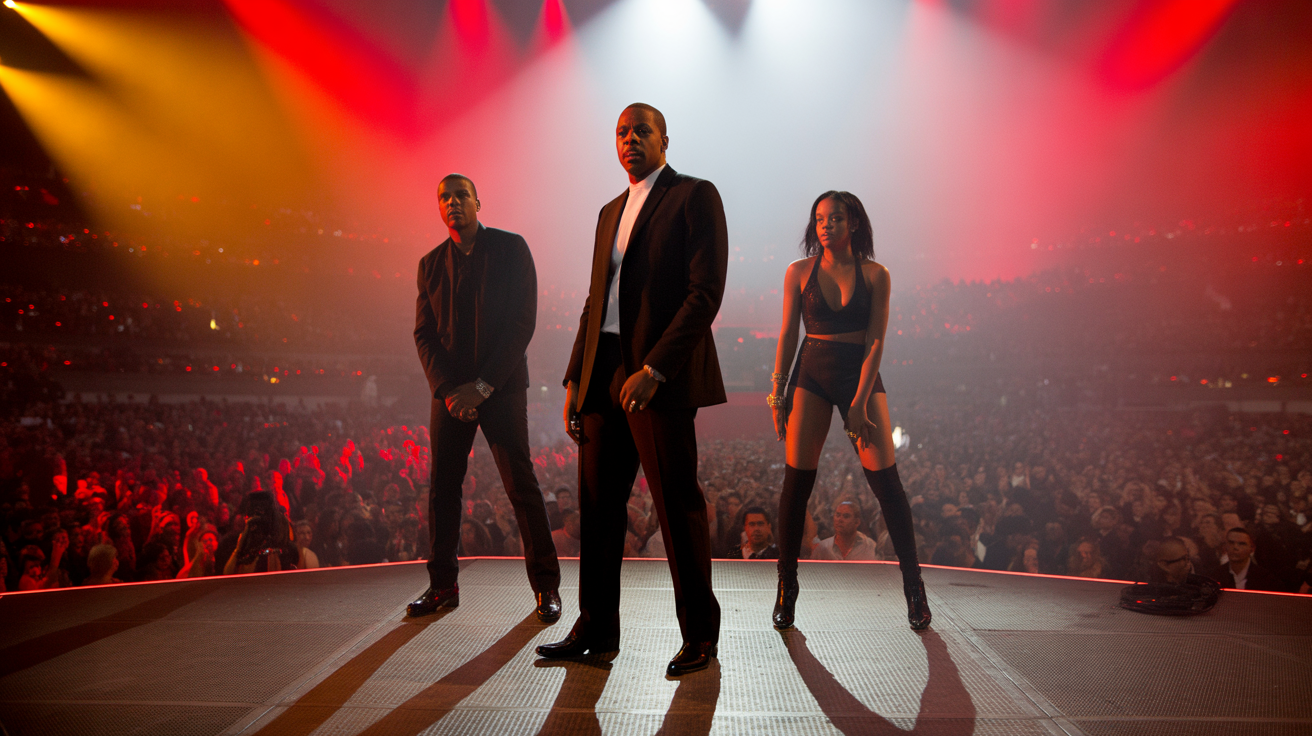
The live debut of “Run This Town” was a moment of sheer, unadulterated star power and calculated cool. The stage was intentionally shrouded in darkness and thick, atmospheric smoke, creating a palpable sense of ominous anticipation that perfectly matched the song’s militant, anthemic tone. Kanye West emerged first from the gloom, delivering his verse with a focused intensity from within the shadows, setting a gritty scene. Rihanna then materialized, a commanding and formidable figure in a black leather outfit, belting out the song’s iconic, hook with a raspy, gritty intensity that showcased her dramatic evolution from a pop singer into a bona fide rockstar and fashion icon.
Finally, Jay-Z strode onto the stage, his mere presence emanating an aura of effortless authority and control. His verse was delivered with a calm, collected dominance that stood in stark contrast to the chaotic energy he would later be associated with that night. The performance was raw, powerful, and impeccably coordinated, a statement of hip-hop’s commercial and cultural dominance in 2009.
It was a showcase of a true hip-hop triumvirate, each artist representing a different facet of the genre’s top tier. The performance’s trustworthiness is highlighted by its clean execution and the undeniable chemistry between the three megastars, a moment of pure, unadulterated musical force before the night’s ensuing controversy.
Beyond the Headlines: Other Performances That Captured the Late-2000s Zeitgeist
The 2009 MTV Video Music Awards were a rich tapestry of musical styles, and beyond the headlining acts were performances that perfectly captured the eclectic and transitional spirit of the late 2000s. Muse made their VMA debut with a blistering, apocalyptic performance of “Uprising,” bringing their brand of virtuosic, sci-fi-inspired rock to a massive mainstream American audience for the first time, a pivotal moment in their career trajectory.
Wale, representing the burgeoning blog-era hip-hop scene, performed his retro-inspired “Chillin,” featuring a surprise guest appearance from Lady Gaga, further cementing her omnipresence on the show and her ability to cross genre boundaries.
Even the winners’ list, detailed in the table below, serves as a perfect time capsule, highlighting the last gasp of pop-punk, the undeniable reign of hip-hop, and the commercial dominance of pure pop music. These elements combined to create a show that was not just about celebrating videos, but about documenting a specific moment in musical history, where genres collided and the digital age began to reshape how music was consumed and celebrated.
Major Winners of the 2009 MTV Video Music Awards
| Award Category | Winner | Video |
| Video of the Year | Beyoncé | “Single Ladies (Put a Ring on It)” |
| Best Female Video | Taylor Swift | “You Belong with Me” |
| Best Male Video | T.I. feat. Rihanna | “Live Your Life” |
| Best New Artist | Lady Gaga | “Poker Face” |
| Best Rock Video | Green Day | “21 Guns” |
| Best Pop Video | Britney Spears | “Womanizer” |
| Best Hip-Hop Video | Eminem | “We Made You” |
The Enduring Legacy: How the 2009 VMAs Redefined the Awards Show Playbook
The 2009 MTV Video Music Awards left a legacy far more enduring than its trophy winners. Its impact resonates in the very fabric of how award shows and pop stars operate today. It became the undeniable benchmark for pop spectacle, fundamentally pushing artists and their creative directors to think of their awards show performances as standalone, must-see events requiring a strong narrative arc, high-concept themes, and if possible, a shocking twist.
The “Gaga model” of theatricality and performance art became a new, influential template that artists like Billie Eilish and Lil Nas X would later iterate upon. Conversely, the Kanye-Taylor incident became a perennial case study in celebrity culture, public perception, cancel culture, and the long, complex arc of public reconciliation. It sparked nuanced conversations about race, gender, entitlement, and mental health in the music industry that continue to this day.
The show proved that in the nascent digital and social media age, a single moment could be clipped, memed, gifted, and discussed endlessly across platforms, giving an awards show a relevance and lifespan that extended for weeks, months, and even years beyond its initial broadcast. The 2009 VMAs demonstrated that the performance, and the drama surrounding it, could ultimately become more iconic than the award itself.
| Artist | 2009 VMA Role | Notable Subsequent Achievement |
| Taylor Swift | Winner, interrupted performer | Became one of the most awarded and bestselling artists in history; Time Person of the Year (2023). |
| Kanye West (Ye) | Performer, interruptor | Continued a controversial yet sonically influential career; faced significant public scrutiny. |
| Beyoncé | Winner, performer | Solidified status as a global icon with groundbreaking visual albums and record-breaking tours. |
| Lady Gaga | Performer, winner | Achieved massive success in music and film (Academy Award winner); became a mental health advocate. |
| Pink | Performer | Continued a record-breaking touring career known for aerial acrobatics; longevity in pop-rock. |
| Green Day | Performer | Inducted into the Rock & Roll Hall of Fame in 2015; continued releasing successful albums. |
Conclusion: The Night the Music World Stopped and Watched
The 2009 MTV Video Music Awards remains a fascinating and indelible cultural artifact. It was a night of stark, dramatic contrasts: sincere tribute and shocking disrespect, polished pop perfection and bloody, avant-garde theatrics, innocent country narrative and aggressive hip-hop dominance. It was a perfect storm of immense talent, unchecked ego, profound tragedy, and pure genius, all unfolding on live television in an era just beginning to understand the power of viral moments.
While one moment of controversy may dominate the collective memory, the true, lasting legacy of the night lies in its breathtaking performances. From Beyoncé’s flawless opener to Gaga’s bloody finale, from Pink’s aerial ballet to Green Day’s rock opera, the show demonstrated the vast and varied power of live music to shock, awe, and move us. It was a night that truly had everything—spectacle, scandal, and sublime artistry—and that is precisely why, over a decade later, we are still analyzing, discussing, and marveling at its audacity.
Frequently Asked Questions
Where were the 2009 MTV VMAs held?
The 2009 MTV Video Music Awards were held at the Radio City Music Hall in New York City, a historic venue that added a layer of prestige to the event.
Who won Video of the Year at the 2009 VMAs?
Beyoncé won the coveted Video of the Year award for her iconic and culturally pervasive “Single Ladies (Put a Ring on It)” video, a win that is still celebrated for its significance.
What exactly was the Kanye West and Taylor Swift incident?
During Taylor Swift’s acceptance speech for Best Female Video, Kanye West stormed the stage, took the microphone from her, and proclaimed that Beyoncé’s “Single Ladies” video was “one of the best videos of all time,” believing it more deserving of the award.
How did Beyoncé respond to Kanye West’s interruption of Taylor Swift later in the show?
When Beyoncé won Video of the Year later in the night, she displayed immense grace and professionalism by calling Taylor Swift back to the stage to finish her speech, a move widely praised as a classy and supportive gesture that partially redeemed the evening’s chaos.
What made Lady Gaga’s 2009 VMA performance so unique and memorable?
Lady Gaga’s performance of “Paparazzi” was a highly theatrical mini-drama that ended with a shocking visual of her suspended in the air, bleeding from a prosthetic wound, symbolizing the dark side of fame and cementing her status as a performance artist.
Did the 2009 VMAs include a tribute to Michael Jackson?
Yes, following a heartfelt introduction by Madonna, Janet Jackson delivered a deeply moving speech in tribute to her late brother, Michael Jackson, which was followed by a powerful montage of his groundbreaking and influential music videos.

Robert Martin is a passionate blogger and versatile content creator exploring the intersections of personal finance, technology, lifestyle, and culture. With a strong background in financial literacy and entrepreneurship, he helps readers make smarter money moves, build sustainable side hustles, and achieve financial independence.
Beyond finance, Robert shares his insights on home decor and gardening—offering practical ideas for creating beautiful, functional living spaces that inspire comfort and creativity. He also dives into the dynamic worlds of sports and celebrity news, blending entertainment with thoughtful commentary on trends that shape today’s pop culture.
From decoding the latest fintech innovations to spotlighting everyday success stories, Robert delivers content that’s informative, relatable, and actionable. His mission is to empower readers to live well-rounded, financially confident lives while staying inspired, informed, and ahead of the curve.